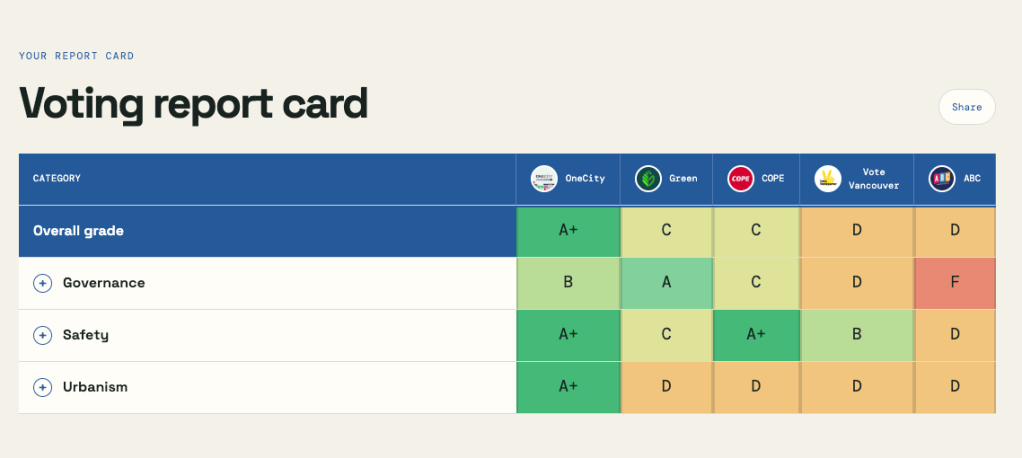
It’s election time! (The municipal one, not the provincial one that no one wanted).
I’m here to help you figure out who to vote for. The first thing I looked at was the voting record of all the parties over the past 4 years. With Rebecca Bligh starting her own party (Vote Vancouver) and Sean Orr winning a by-election (COPE), we have 5 different political parties with records to analyze.
I did a similar analysis back in 2022 focusing on housing and the environment. Not everyone agreed with my grading, so this time I built an interactive website where you can pick the categories that you care about and overwrite my grading scheme if you want.
Welcome to to the Vancouver Council Scorecard.
I analyzed and categorized the 75 most consequential votes from the past 4 years into 7 categories:
- Housing
- Transportation
- Environment
- Safety
- Affordability
- Governance
- Urbanism
Once you pick a category, you can expand it to see all the votes that make up the scoring. If you disagree with how I’ve graded it, you can override it. If you think that Bitcoin is “the greatest invention in human history”, you can change the weight on that vote, or any other. You can also click on a party to see the voting record of each individual councillor.
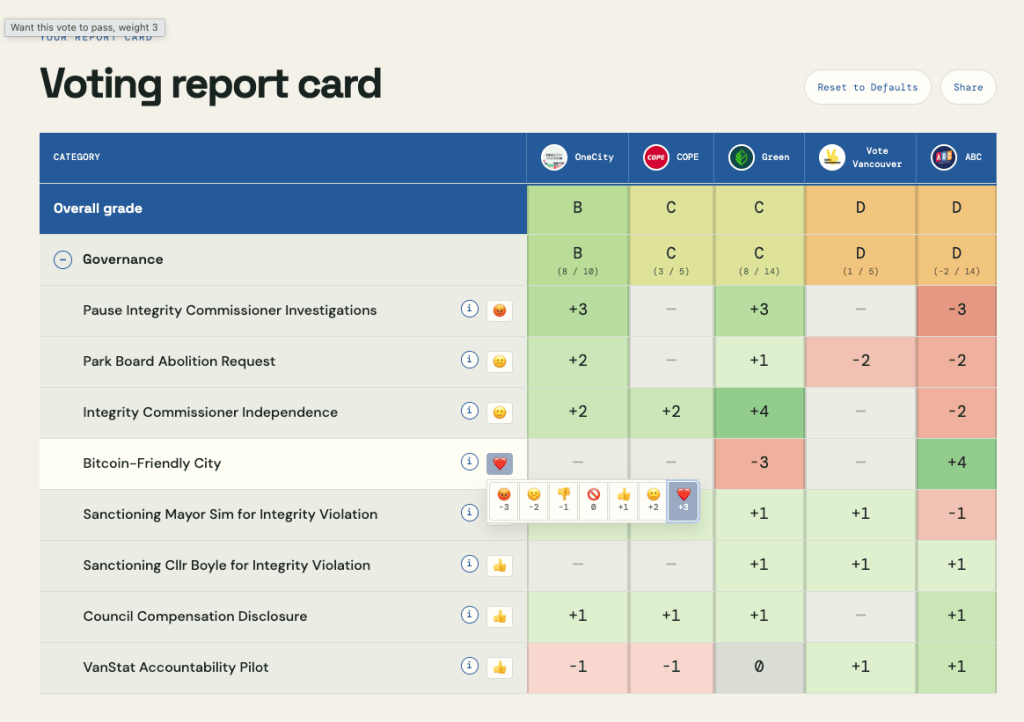
Before anyone criticises this as AI slop, yes I used codex to help me write the code. I’m not a sadist and I don’t have endless hours to build a polished UI, especially when AI can generate in minutes. Instead I spent my time reading through pages of council minutes, tons of news stories, and grading the votes from the past 4 years. Something AI had a much harder job with.
Vancouver has a decent open-data source of council votes, which I heavily relied upon. Unfortunately, it hasn’t been updated since April and is missing some very important votes – like the Villages Plan, allowing natural gas in new construction and blocking OPS in downtown Vancouver.
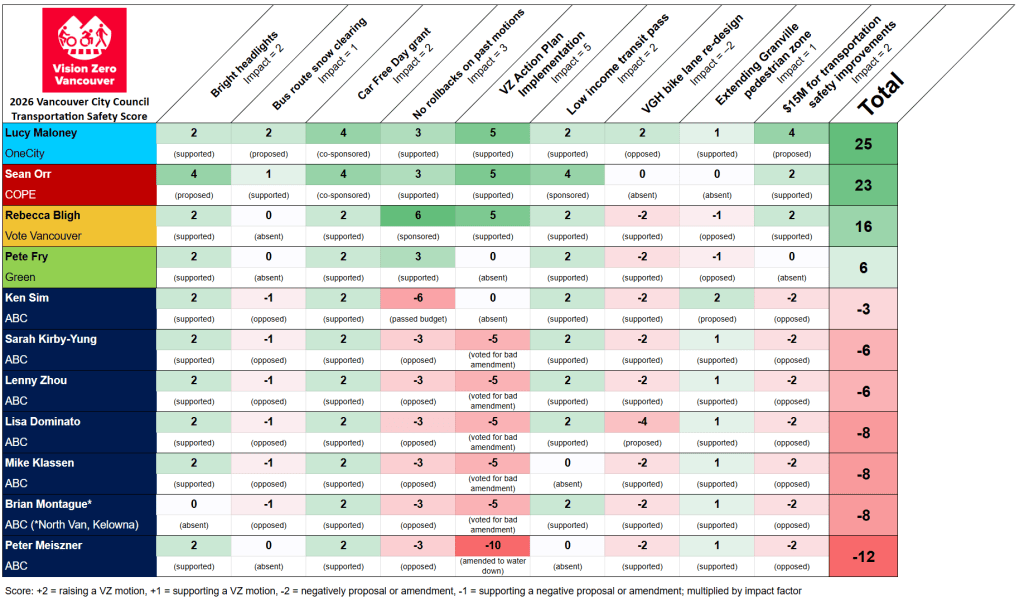
My analysis was inspired by the excellent report card that Vision Zero Vancouver put out. I even stole their grading system, where votes have impact weighting and councillors who propose motions get double points.
Let me know what you think of the Vancouver Council Scorecard. Are there any votes I missed? Are my default weightings way off? Was I too hard on ABC?
I hope to have more analysis up in the next few days as we approach October 3 – the first day of advance polls, including recommendations on who to vote for.
UPDATE: Now with a quiz
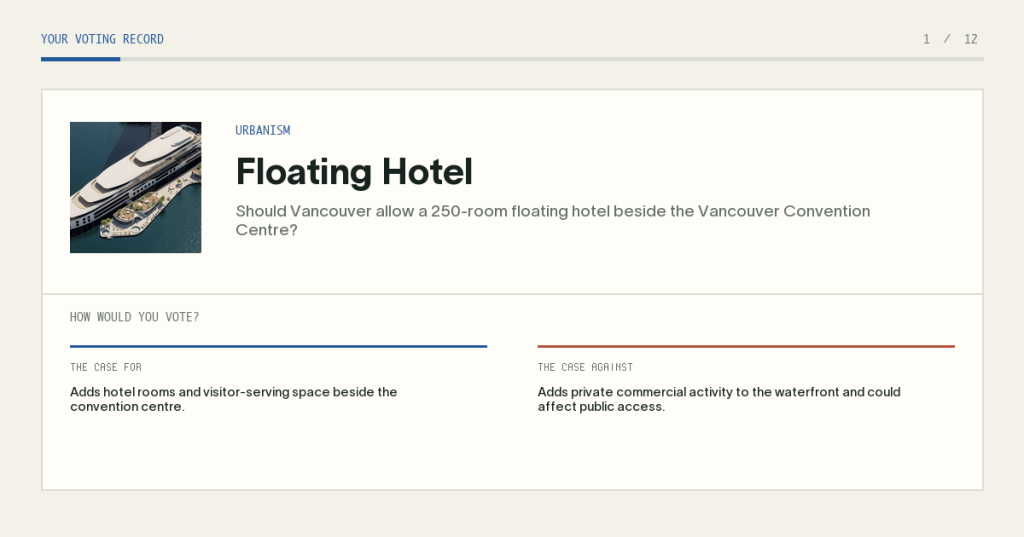
I also added a quiz to keep the choices simpler. 12 defining votes that distinguish where the parties stand on the issues over the past 4 years. Check it out and see who you align with.


Love these tools! The quiz was a huge hit with my teen who is curious to better understand how their developing political views align with the parties running in the municipal election (minus Vancouver Liberals and TEAM since they don’t have voting records from the last Council).
I’m wondering, though, if the Overall Grades on the scorecard need to be adjusted. When testing it with three issues: Party 1 received B, A+ & D (Overall Grade = A), Party 2 received A, A+ & C (Overall Grade = B), and Party 3 received C, A & C (Overall Grade = B). The A given to Party 1 seems off, especially given that they received a D on one of my top three issues.
LikeLike
I’ll take a look at the weighting. I’m guessing the issue is that Housing has more votes in it and is getting a higher weight in the overall score, instead of normalizing which would make more sense.
LikeLike
[…] are 7 serious parties on the ballot (and a few others not worth mentioning). I created a Council Scorecard and a quiz based on the past voting records of the elected parties. The quiz in particular is a […]
LikeLike