In November 2022, I created a bunch of maps visualizing the EV fast-charging infrastructure in Canada and the USA. It’s time to revisit those maps and see what has changed in the past 18 months, as the number of charging stations has roughly doubled in both countries.
The maps I generated look at sections of major highways in both countries and categorize them based on the distance to the nearest EV fast charger. From our experience taking an EV road trip across Western Canada, range anxiety kicked in when the distance between chargers was over 200 km, especially after encountering malfunctioning charging infrastructure in small towns.
The maps below use the following categorization:
- Great: < 50 km from a charger. No need to route plan; just look for the next charger when you get low.
- Good: 50-100 km. Stress-free driving.
- Doable: 100-200 km. Route planning is required, but you have backup options.
- Hard: 200-300 km. Pray that there isn’t a broken charger or a queue.
- Risky: 300-350 km. If everything goes right, you might just make it.
- Inaccessible: >350 km. Don’t bother.
Canada


In Canada,
- The number of stations has grown from 739 to 1662 (125% increase).
- Quebec had good coverage before. Now it is plastered with fast chargers covering all the populous southern parts of the province.
- The big gaps between Saskatoon and Winnipeg, and Saskatoon and Calgary have been filled in with new fast chargers in places like Kindersley and Yorkton.
- There is still a big hole around Whitecourt, AB and the highway up to Fort McMurray (which I’m sure is mostly symbolic at this point).
- The northern parts of Canada are still pretty hostile to EVs, but progress is steadily being made. Pretty soon you’ll be able to road trip from Vancouver to Whitehorse with comfortable fast charging along the way.
United States


In the United States,
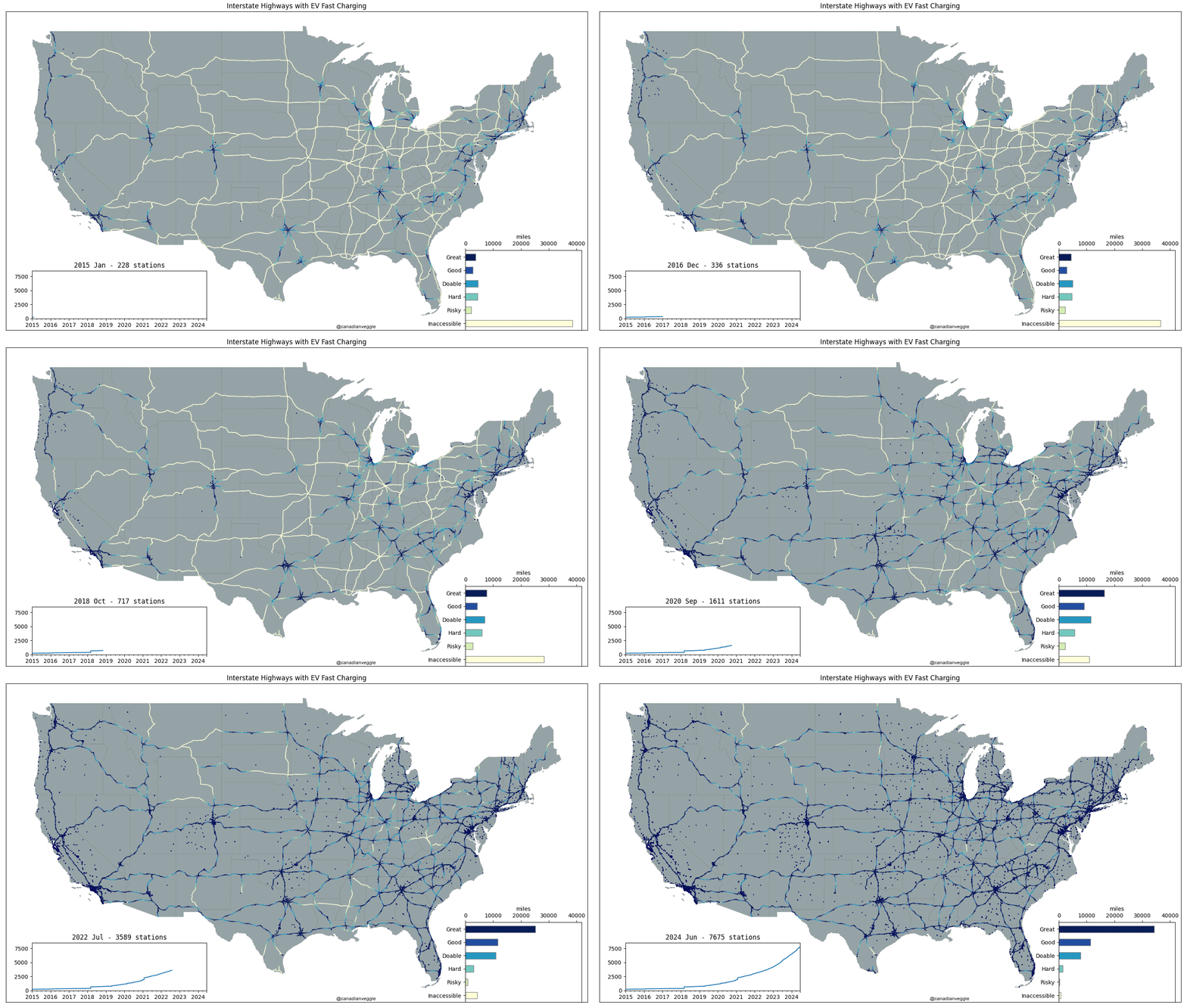
- The number of stations has grown from 4024 to 7675 (91% increase).
- Almost every interstate highway has good fast-charging infrastructure.
- The major gaps in Texas, Mississippi, and West Virginia that existed in 2022 have been filled in.
- The remaining gaps are mostly in Montanna.
Animated Gifs
The animated maps really show the progress since 2015. Range anxiety is quickly becoming a worry of the past.

For simplicity, the maps above look at chargers with the most popular SAE J1772 connectors. I also did some analysis of Tesla’s charging stations which you can find on GitHub, along with all the python code used to generate the maps.
 Canadian Veggie
@canadianveggie.com In the midst of planning our first major EV road trip from Victoria to Sask, loop around and back. According to plugshare the trans canada and all the major highways are now very good. The issue is between Saskatoon and Calgary. Kindersly is too far from Calgary for most EVs and we will need at least one more charge. There is Hanna and Drumheller now, but I hate planning around 1 single charger in the middle of nowhere which could be broken.
LikeLike
Remote Reply
Original Comment URL
Your Profile
Why do I need to enter my profile?
This site is part of the ⁂ open social web, a network of interconnected social platforms (like Mastodon, Pixelfed, Friendica, and others). Unlike centralized social media, your account lives on a platform of your choice, and you can interact with people across different platforms.
By entering your profile, we can send you to your account where you can complete this action.
Yes. That section is doable, but only if everything works properly. And the Hanna charger is only rated 5.7 on PlugShare – a little anxiety inducing for sure.
The Hanna and Kindersley stations didn’t exist when we did our road trip in 2022, so things are improving, but Saskatchewan and Alberta still have a lot of catching up to do.
LikeLike
[…] created by Canadian VeggieThe map above shows just how quickly the EV fast charging network has grown along US Interstate […]
LikeLike
[…] has the most electric vehicles (EVs) in Canada, thanks to government subsidies and one of the best charging networks in North America. Our clean energy advantage is now powering a clean transportation […]
LikeLike
The surge in EV chargers is promising—more stations mean less range stress. But growth needs to match demand, especially in rural and highway spots. Solid breakdown—thanks for the analysis.
LikeLike